What Is Blog Submission in SEO?
Blog submission (also called article submission) is an off-page SEO technique where you publish original content — an article, blog post, or guest post — on a third-party website, platform, or publishing network, with a link back to your own site included.
Unlike guest posting, which usually requires pitching an editor and going through an approval/editorial process on a specific blog, blog and article submission sites are typically open publishing platforms (like Medium, HubPages, or Tumblr) where you can create an account and publish content more freely, though many still have quality guidelines.
In simple terms: blog submission = writing valuable content and publishing it on a trusted, high-authority platform, with a natural link pointing back to your website.
Blog Submission vs. Article Submission vs. Guest Posting
These three terms overlap but aren’t identical:
- Blog submission sites — platforms where you publish a full blog post under your own or a branded profile (e.g., Medium, Tumblr, Blogger, Substack).
- Article submission sites — directories or publishing platforms built specifically for informational articles, often organized by category (e.g., HubPages, EzineArticles, Scoop.it).
- Guest posting — pitching and publishing a one-off article on someone else’s established blog, usually through editorial approval, often on a niche-relevant site.
All three fall under content-based link building, and most well-rounded SEO strategies use a mix of all three.
Role of Blog & Article Submission in SEO
Despite algorithm updates over the years, blog and article submission remains a relevant off-page SEO tactic in 2026 — when done with quality in mind. Here’s the role it plays:
1. Builds Quality, Contextual Backlinks
A backlink placed naturally inside a well-written article carries more SEO weight than a link dropped in a random directory, because it’s surrounded by relevant, readable context.
2. Increases Domain Authority Over Time
Publishing consistently on high-DA platforms (Medium, LinkedIn Articles, Substack, HubPages) contributes to a diversified, natural-looking backlink profile — a key trust signal for search engines.
3. Drives Referral Traffic From Engaged Readers
Blog and article platforms often have built-in, topic-interested audiences. A useful article can drive real clicks to your website, not just link equity.
4. Expands Content Reach and Repurposing
Submitting adapted or summarized versions of your existing blog content to other platforms extends its lifespan and reach without creating content from scratch every time.
5. Builds Topical Authority and E-E-A-T
Regularly publishing informative, well-researched content across reputable platforms strengthens your brand’s Experience, Expertise, Authoritativeness, and Trustworthiness (E-E-A-T) — a factor Google explicitly considers in ranking content.
6. Supports Faster Indexing
High-authority publishing platforms are crawled frequently by Google. A link on one of these can help new content or pages on your own site get discovered and indexed sooner.
Benefits of Blog Submission Websites
- Free (in most cases) — most reputable platforms let you publish at no cost
- Quality backlinks from high-DA, frequently crawled domains
- Referral traffic from readers genuinely interested in your topic
- Improved brand visibility and thought leadership
- Long-term content assets that keep working long after publishing
- Diversifies your backlink profile with contextual, content-based links
- Complements guest posting and other off-page SEO efforts
Free Blog & Article Submission Website List
Below is a categorized starter list of well-known, widely used blog and article submission platforms. Domain Authority and traffic can shift over time, so treat DA figures as approximate and always confirm current submission guidelines before publishing.
High-Authority Blogging & Publishing Platforms
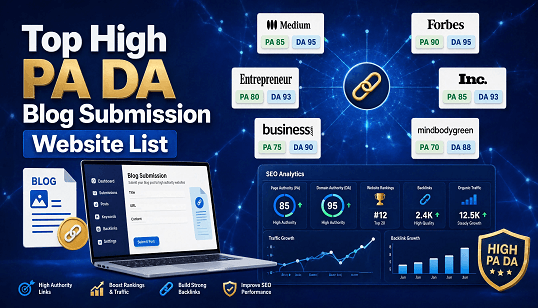
| S. No | High PA DA Blog Website List | Submission | DA |
| 1 | https://medium.com/ | Blog Post | 95 |
| 2 | https://www.whizolosophy.com/ | Blog Post | 41 |
| 3 | https://vocal.media/ | Blog Post | 77 |
| 4 | https://hashnode.com/ | Blog Post | 61 |
| 5 | https://timebusinessnews.com/ | Blog Post | 95 |
| 6 | https://bcz.com/ | Blog Post | 60 |
| 7 | https://www.zupyak.com | Blog Post | 77 |
| 8 | https://medium.com | Blog Post | 57 |
| 9 | https://wordpress.com/ | Blog Post | 77 |
| 10 | https://stck.me/ | Blog Post | 57 |
| 11 | mystrikingly.com | Blog Post | 95 |
| 12 | https://www.blogger.com/ | Blog Post | 54 |
| 13 | https://www.tumblr.com/ | Blog Post | 47 |
| 14 | wordpress.com | Blog Post | 77 |
| 15 | https://www.sociomix.com/ | Blog Post | 95 |
| 16 | https://weebly.com/ | Blog Post | 95 |
| 17 | wordpress.com/ | Blog Post | 95 |
| 18 | https://differ.blog/ | Blog Post | 54 |
| 19 | https://timebusinessnews | Blog Post | 95 |
| 20 | https://vocal.media | Blog Post | 60 |
| 21 | https://timebusinessnews.com | Blog Post | 4 |
| 22 | https://naasco.substack.com/ | Blog Post | 95 |
| 23 | https://www.globalair.com/ | Blog Post | 95 |
| 24 | https://www.bizforgeusa.com/ | Blog Post | 55 |
| 25 | https://www.ranksrocket.com/ | Blog Post | 95 |
| 26 | https://blogspot.com/ | Blog Post | 47 |
| 27 | wixsite.com | Blog Post | 95 |
| 28 | viadjusters.com | Blog Post | 20 |
Tip: Don’t try to submit the same article to every platform on this list. Choose 5–10 platforms most relevant to your niche and audience, and tailor each submission rather than copy-pasting identical content everywhere.
How to Do Blog Submission the Right Way (Step-by-Step)
Step 1: Write Original, Valuable Content
Never submit duplicate or spun content. Each submission should offer genuine insight, data, or a unique angle — not just reworded versions of the same article.
Step 2: Choose the Right Platform for Your Niche
A finance article performs better on a business-focused platform; a coding tutorial belongs on DEV Community or Hackernoon. Relevance matters more than raw DA.
Step 3: Follow Each Platform’s Content Guidelines
Every platform has its own formatting rules, word count expectations, and content policies. Review these before submitting to avoid rejection or removal.
Step 4: Place Your Link Naturally
Insert your website link within the body where it adds genuine value (e.g., citing a source, linking to a related resource) or in your author bio — never forced or over-optimized with exact-match anchor text.
Step 5: Optimize for On-Page SEO
Use a clear title, relevant keywords, proper headings, and a meta description (where the platform allows it) to help the article perform well even on the third-party site.
Step 6: Promote Your Submitted Content
Share the published article on social media and relevant communities to drive initial traffic and engagement — this also signals quality to the hosting platform’s algorithm.
Step 7: Track Performance and Repeat Consistently
Monitor referral traffic and backlink status using analytics tools, and treat blog submission as an ongoing content distribution habit, not a one-time task.
Free vs. Paid Blog Submission Sites
Most reputable blog and article submission platforms are free to use. Paid options typically offer:
- Faster editorial review or guaranteed publishing slots
- Premium placement or featured listings
- Access to a larger, more targeted existing audience
Free platforms remain a great starting point, but as your content strategy matures, a mix of free submission sites and select paid or pitched guest posts on niche-relevant blogs tends to deliver the strongest long-term results.
Common Mistakes to Avoid
- Publishing duplicate content across multiple platforms without modification — this can trigger duplicate-content SEO issues
- Keyword-stuffing anchor text — use natural, varied anchor text instead of repeating exact-match keywords
- Submitting to low-quality or spammy platforms — sites full of ads, spun content, or no real readership add little SEO value and can look manipulative
- Ignoring platform-specific guidelines — leads to rejected submissions or removed backlinks
- One-and-done submissions — consistent, ongoing publishing performs far better than a single burst of submissions
- Overloading articles with links — one or two natural, relevant links is far more effective than link-stuffing
Is Blog Submission Still Effective for SEO in 2026?
Yes — when the focus is on quality content over quantity of submissions. Search engines have become much better at detecting thin, duplicate, or spun content, which means genuinely useful articles published on relevant, reputable platforms still contribute meaningfully to:
- A natural, diversified backlink profile
- Referral traffic from real, interested readers
- Stronger topical authority and E-E-A-T signals
- Long-term brand visibility across the web
The outdated approach of mass-submitting the same spun article to hundreds of low-quality sites no longer works — and can actively hurt your SEO. The 2026 approach is: fewer, better, more relevant submissions.
Frequently Asked Questions
What is blog submission in SEO? It’s the practice of publishing original blog or article content on third-party platforms to earn backlinks, referral traffic, and brand visibility.
Is article submission still a good SEO strategy? Yes, as long as the content is original, valuable, and published on relevant, reputable platforms rather than spammy directories.
What’s the difference between blog submission and guest posting? Blog submission typically uses open, self-publish platforms (Medium, Tumblr), while guest posting involves pitching and getting approved by an editor on a specific, often niche-relevant blog.
Are blog submission sites free? Most major platforms (Medium, Blogger, Tumblr, HubPages, Quora) are free to use, though some offer paid premium features or faster review.
How many articles should I submit per month? Quality and consistency matter more than volume — 2 to 4 well-written, platform-appropriate submissions per month is a sustainable, effective pace for most businesses.
Final Thoughts
A well-curated blog submission website list remains a valuable part of a modern off-page SEO strategy — but only when paired with genuinely useful, original content. Choose platforms relevant to your niche, write for readers first, place links naturally, and treat submission as an ongoing content distribution habit rather than a one-time backlink push. Done this way, blog and article submission still delivers real backlinks, real traffic, and real brand authority in 2026.